
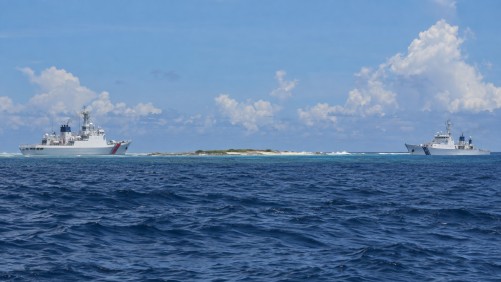
China has urged the Philippines to cease what it describes as provocative actions in the South China Sea, emphasizing its commitment to protecting its territorial sovereignty and maritime interests. This call from Beijing follows a recent Philippine supply mission to a grounded vessel at Ren’ai Jiao, known internationally as Second Thomas Shoal. Despite warnings from China, the Philippine vessel proceeded with its mission, prompting a response from the Chinese coast guard.
According to Chinese authorities, their coast guard closely monitored the Philippine ship and issued appropriate warnings during the operation. China asserts that its actions in the area are lawful and necessary to uphold its maritime rights. Moreover, Beijing accused the Philippines of breaching agreements under the Declaration on the Conduct of Parties in the South China Sea, warning that such actions could disrupt peace and stability in the region.
China has reiterated its intention to continue law-enforcement operations around Ren’ai Jiao and other parts of the Nansha Qundao, also referred to as the Spratly Islands. The ongoing tension highlights the complex territorial disputes in the South China Sea, which is a strategic and resource-rich area claimed by multiple countries.
The recent developments underscore the persistent challenges in managing disputes in the South China Sea, where national interests and international law often collide. As China and the Philippines navigate these tensions, the broader geopolitical implications continue to attract international attention, reflecting the region’s significance in global maritime security. The situation remains delicate, with both nations needing to balance their national interests with regional stability.